→ AI-native studio · Est. 2026
Putting AI to work
for Filipino founders
& teams.

I work as an AI orchestrator, wiring agents, model routing, and automation pipelines into systems that run on their own. One operator, delivering the output of a full crew: sites, automations, content, and the training to run it all.
shipping AI, from marine-science research to enterprise operations
Philippine landscapes rendered live in 3D from NASA data (LANTAW), built in a weekend
straight days of fully automated AI news drops via VCPH OS, zero manual touch
registrations for the Gen AI to Z summit I directed
What I run.
I work as an AI orchestrator. I design and run systems of agents, models, and pipelines so one operator ships what used to take a whole team. Here is what you can hire me for.
Build
Websites, web apps, CRMs, and dashboards, production-grade and yours to keep. I orchestrate AI coding agents to ship in days what usually takes weeks. The Watch Alley is a live commerce site running on Supabase.
Automate
I find the bottleneck first, then build the pipeline that removes it: lead capture, reporting, content, and daily operations. VCPH OS is one I run for myself, a daily news pipeline that has published 38+ days with zero manual touch.
Create
Content production that used to need a research team, a studio, and an editor, now delivered by one operator with the right tools. I route across models for image, video, and narration, then automate the whole publish loop.
Advise
I help teams adopt AI without wasting budget on the wrong tools. Workflow audits, vendor and model selection (Claude Code vs Codex, which model fits which job), and hands-on training so your people actually use it. 6+ years shipping AI, from research to enterprise operations.
Need something else, from AI-powered hardware to a launch event? I have shipped all of it. Tell me what you need.
Things I have shipped.
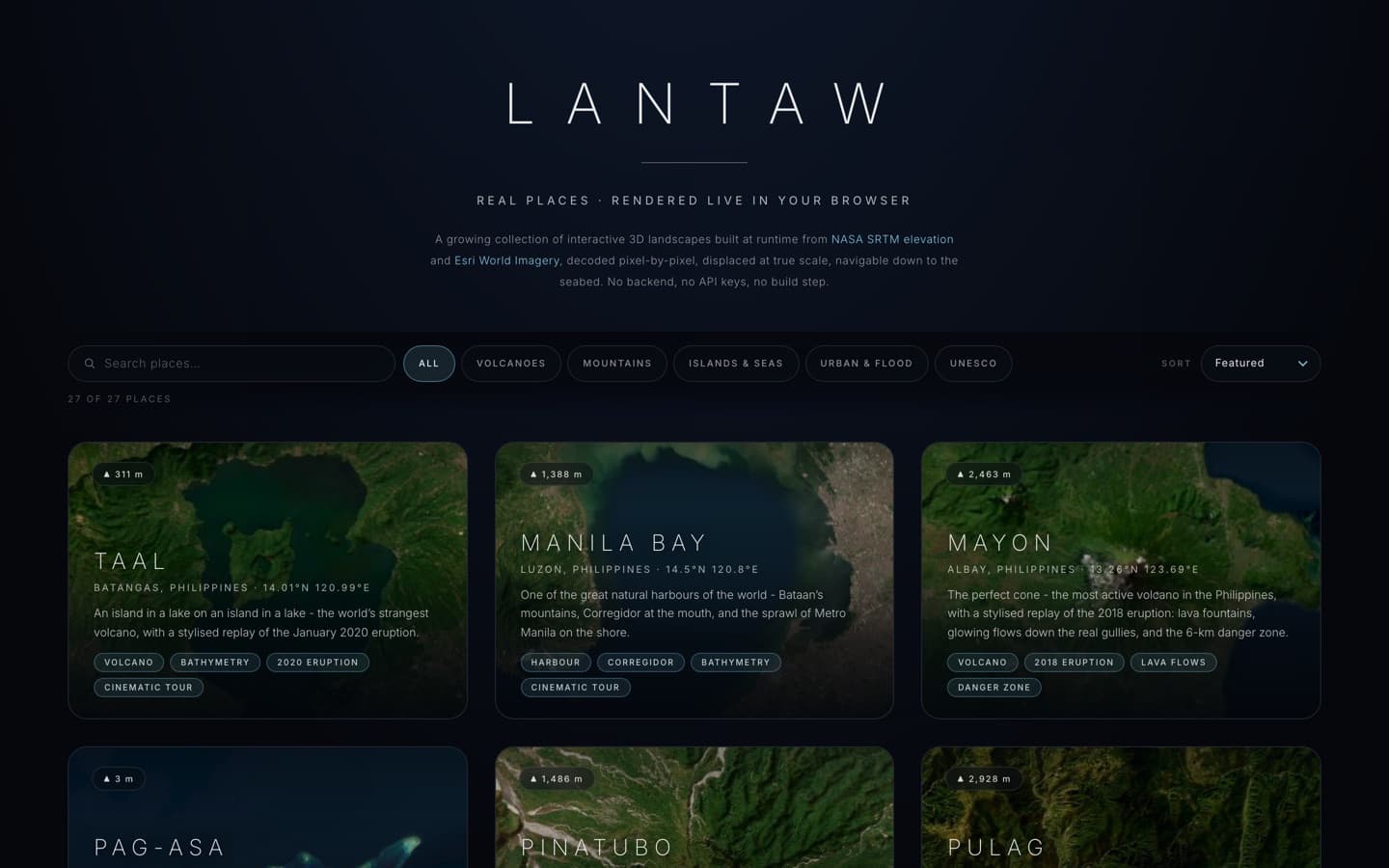
LANTAW
Interactive 3D landscapes rendered live in the browser from NASA elevation data and satellite imagery. 27 Philippine places so far, from Taal and Mayon to Banaue and El Nido, each with real bathymetry and cinematic tours.
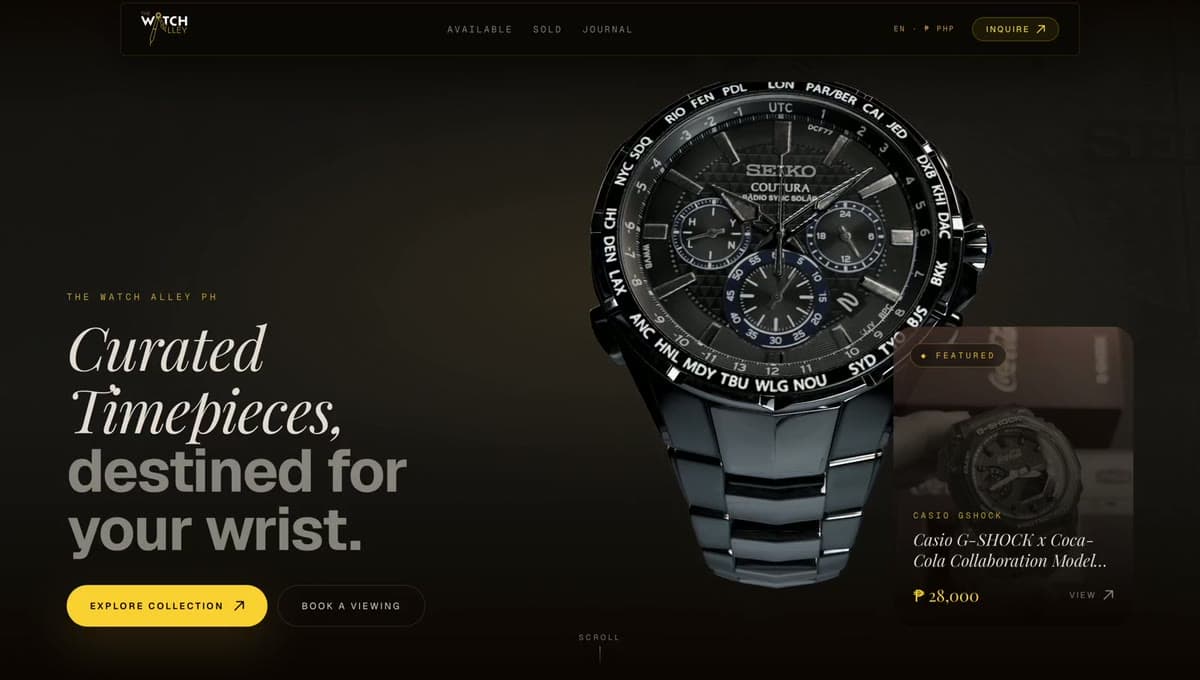
The Watch Alley
A conversion-focused commerce site for Filipino watch collectors: Supabase-backed inventory, product pages built to sell, admin tooling, and content workflows. Live and in active development.
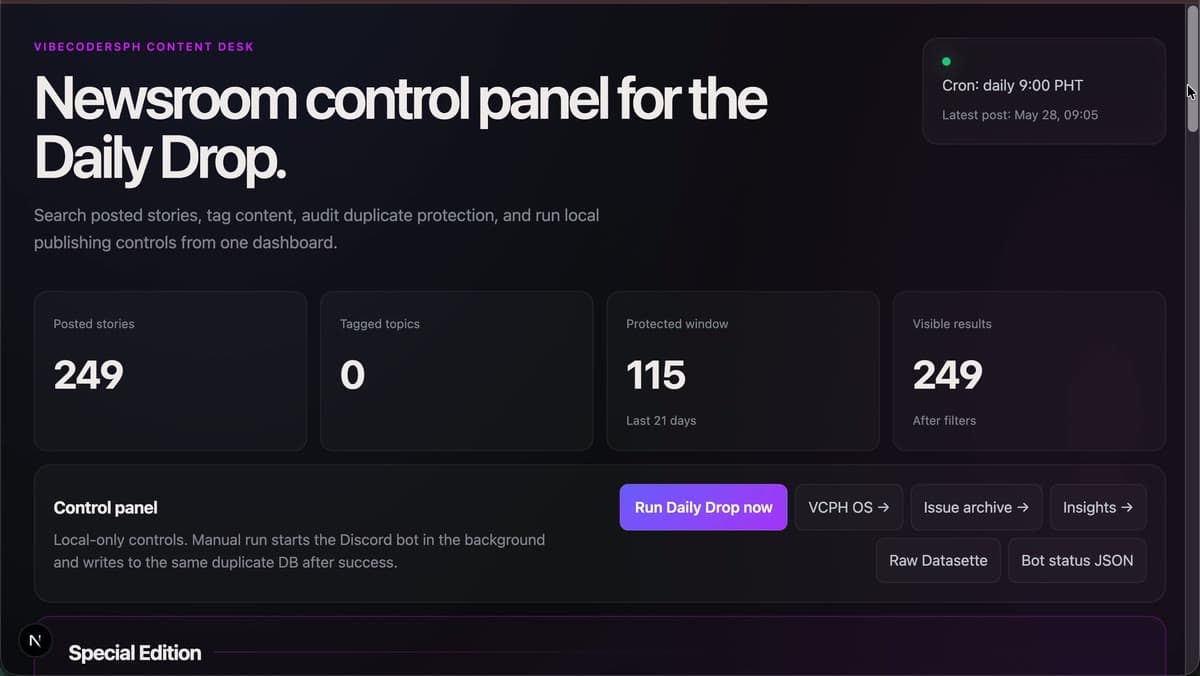
VCPH OS
A fully automated daily AI-news pipeline: 30+ feeds in, curated and rewritten in a Pinoy-aware voice, AI cover art, vision QA, then auto-published to Discord, Telegram, and X. Zero manual touch.

Condo 3D Studio
A Manila studio condo redesigned from 7 client photos: two full schemes, nine geometry-preserving AI renders, a dimensioned floor plan, cinematic flythroughs, and an interactive 3D walkthrough with VR and GLB export.
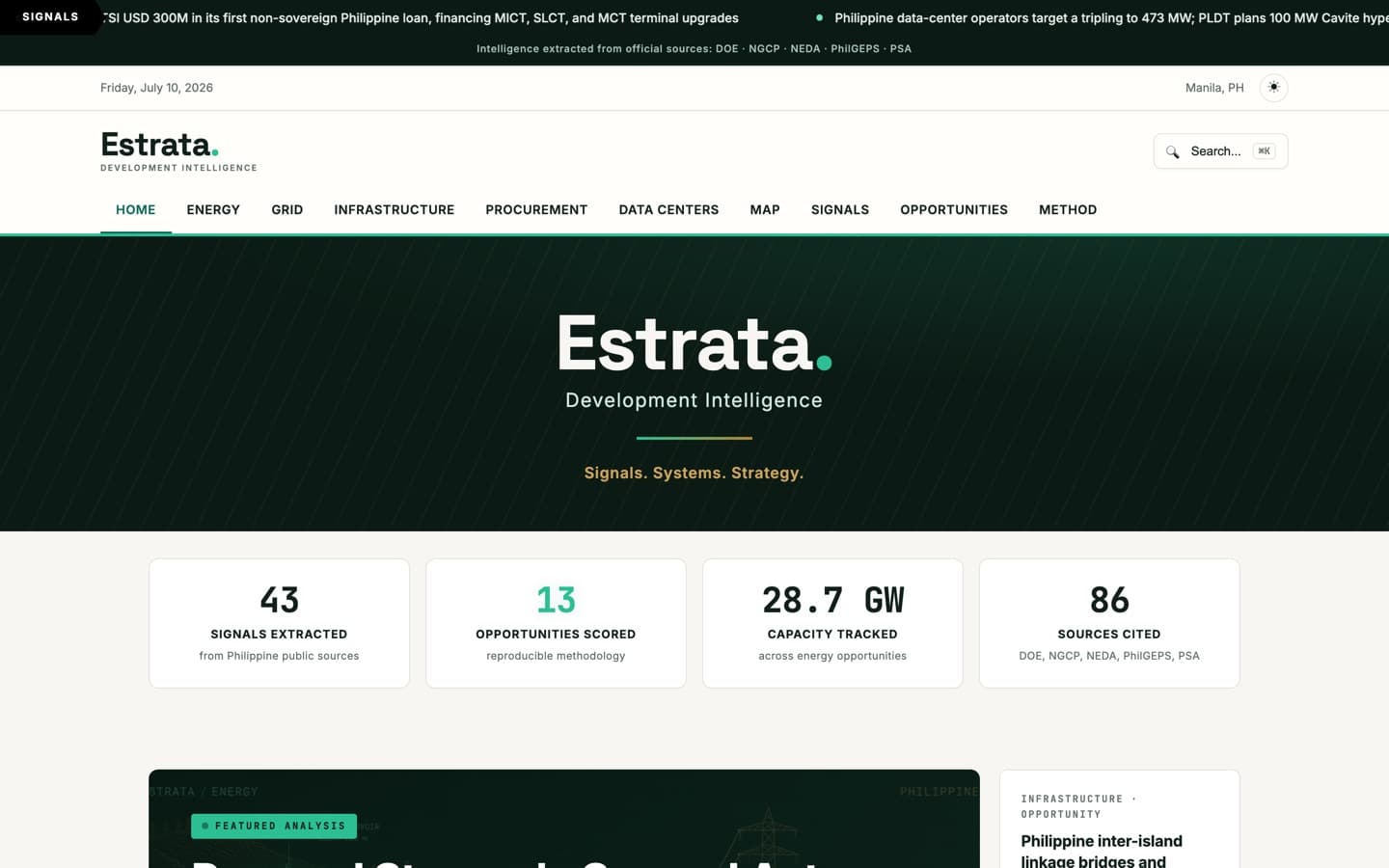
Estrata
An AI development-intelligence platform that turns fragmented Philippine public data (budgets, procurement, energy, infrastructure) into investor-grade analysis, on a multi-agent research pipeline.
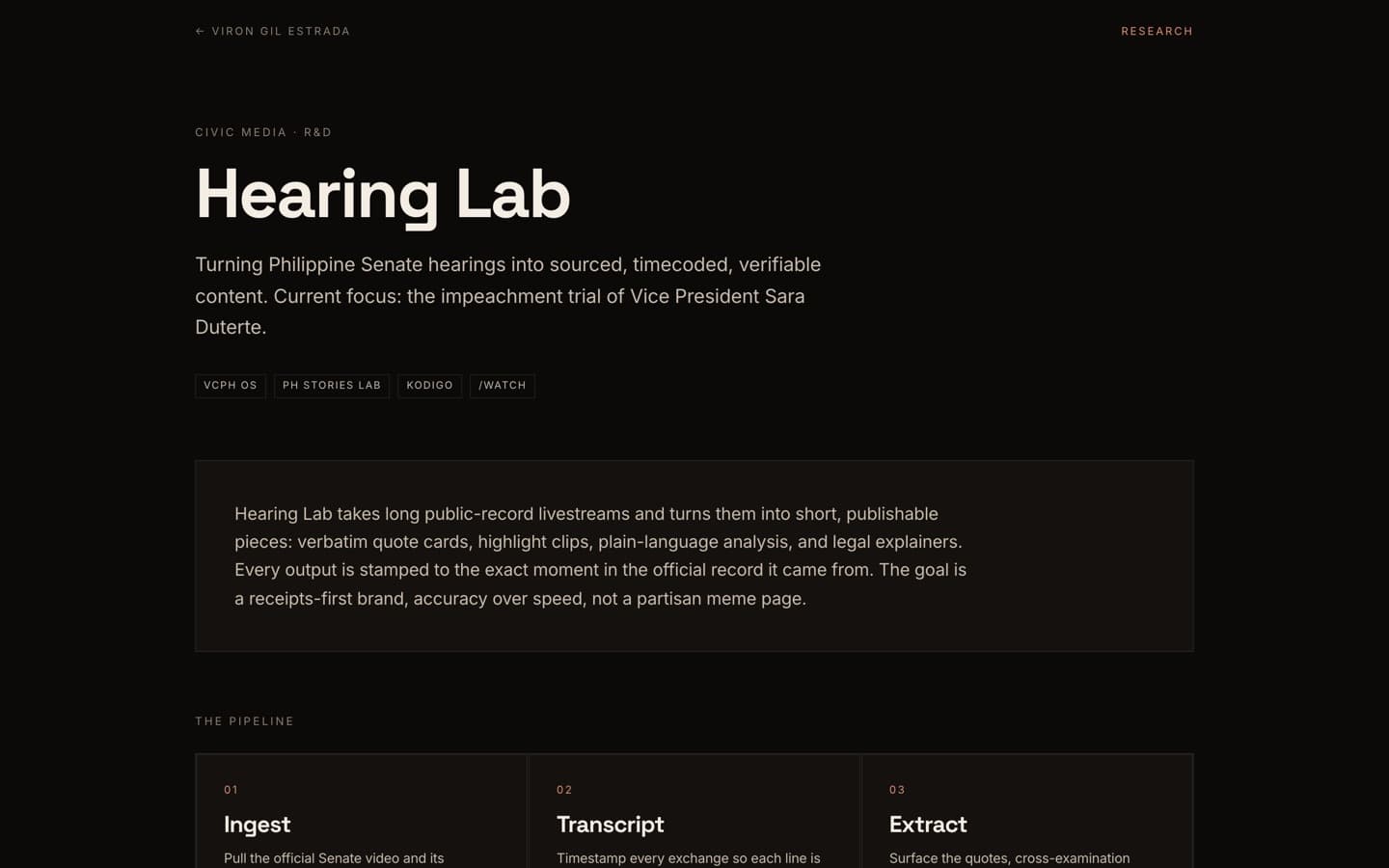
Hearing Lab
A pipeline that turns Philippine Senate hearings, currently the impeachment trial of VP Sara Duterte, into sourced, timecoded content: verbatim quotes, highlight clips, and plain-language legal explainers. Receipts-first, accuracy over speed.
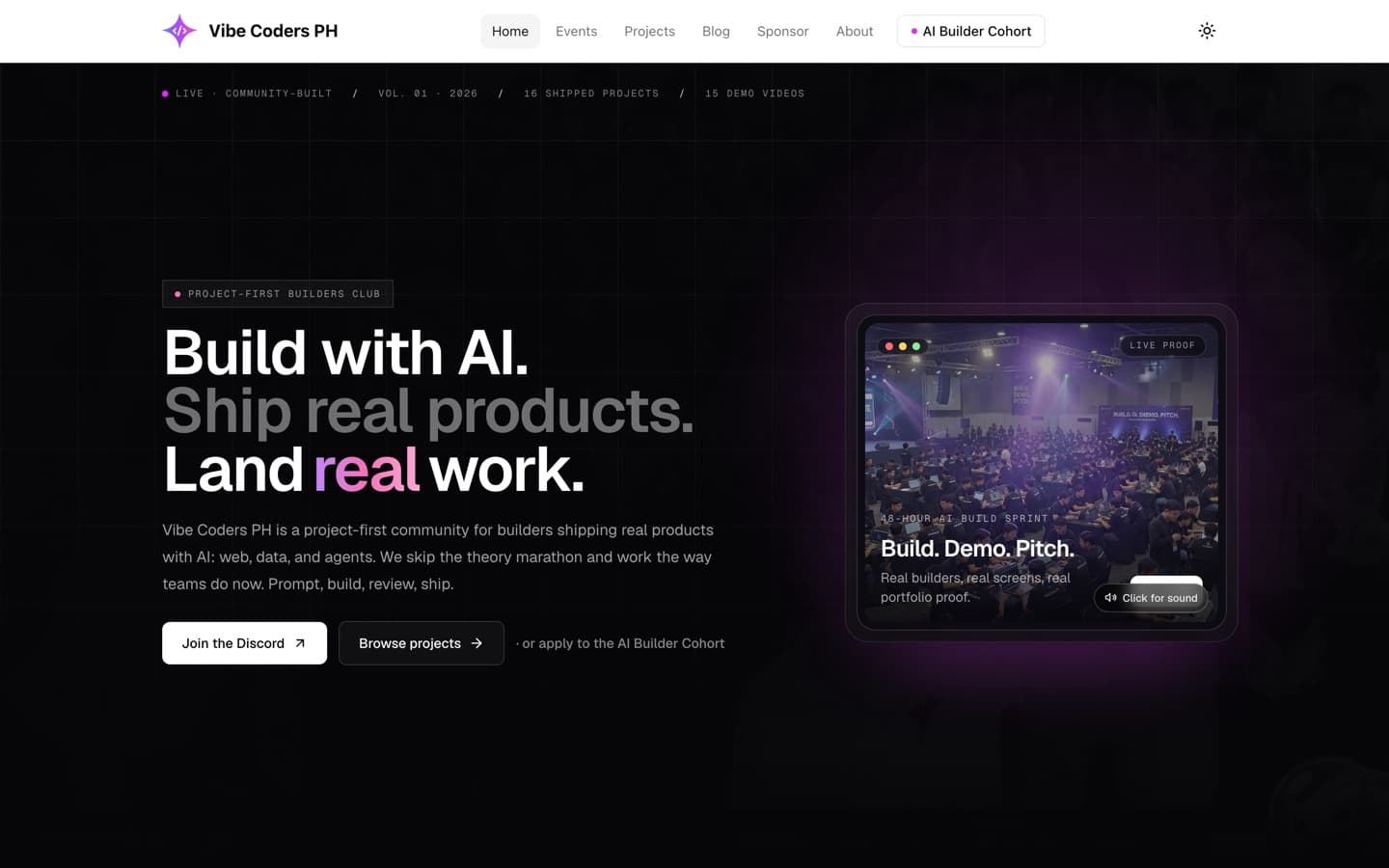
Vibe Coders PH
The AI-native builder community I founded: events, cohorts, certificates, and a job board for Filipino builders across web, AI, and data.
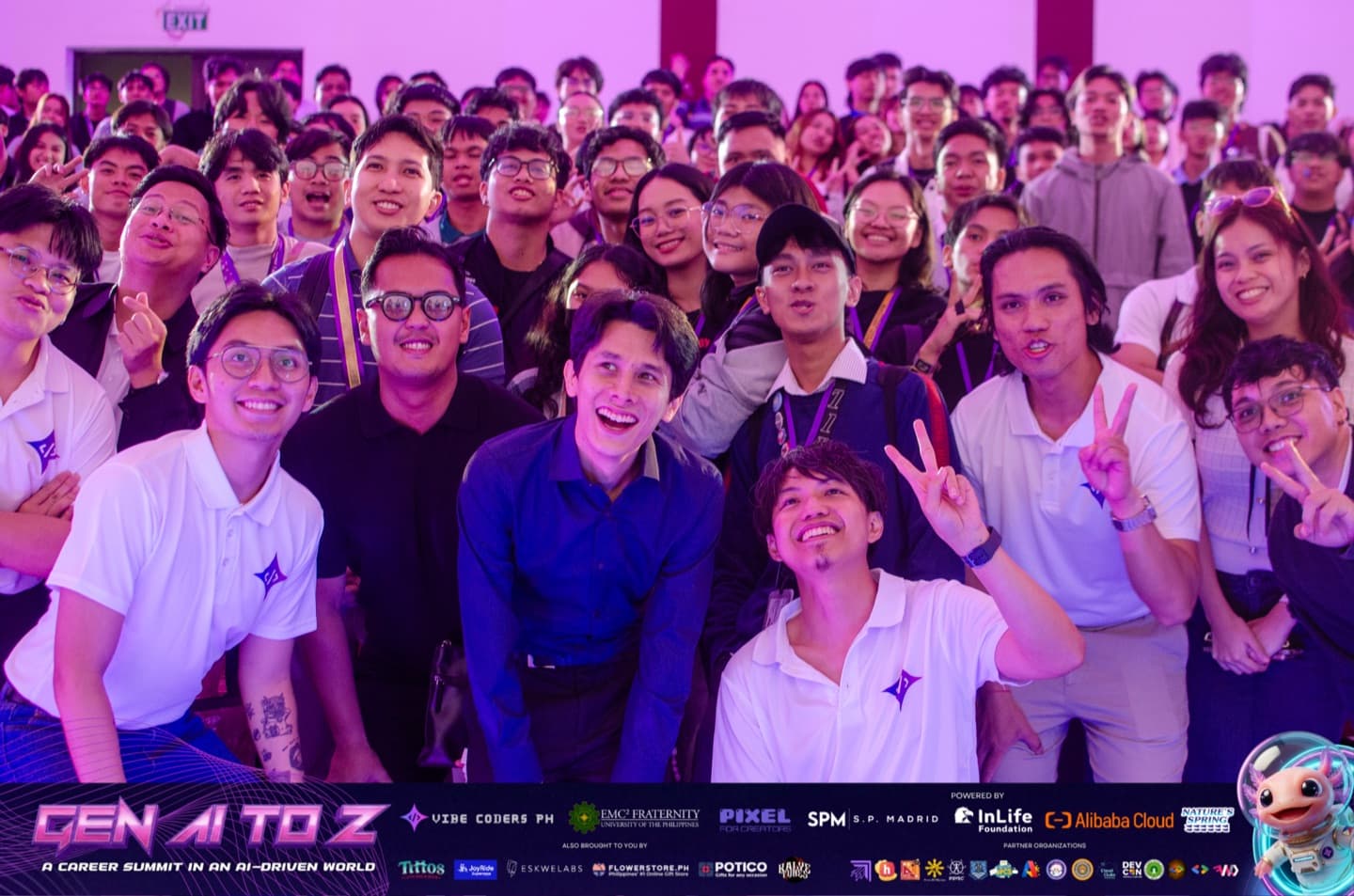
Gen AI to Z
The AI career summit I directed at UP Diliman: 795 registrations and 333 people in a 256-seat hall, with AI-assisted operations run end to end.
More on LinkedIn · and the Ship Happens hackathon concept.
25 worlds, one at a time.
A public design exercise in range: twenty-five fundamentally different websites, each with its own visual language, interaction model, and build guide. Directed by me, built with Claude and Codex, shipped one at a time.
 Experiment 09
FORMA
A real-time WebGL gallery of generative sculpture.
 Experiment 08
OVERWORLD
A handmade pixel game studio with a demo you can play.
 Experiment 07
TECTONIC
A brutalist archive whose concrete remembers it was liquid.
09 of 25 live · new worlds shipping continuously
Explore all experimentsFresh from the bench.
Small things I build and ship as I learn. Rougher than the flagship work above, but live and real. Updated as I go.
Tier Split
Built a small working router on DeepSeek-V4-Flash-0731's July 31 public beta: set a monthly Opus-5-only coding spend and what share of that work is boilerplate, boilerplate routes to DeepSeek at $0.14/$0.28 per Mtok, everything else stays on Opus 5, and see the resulting cost against a blended Terminal-Bench 2.1 score (82.7 DeepSeek vs 89.1 Opus 5) so the savings sit next to the actual quality tradeoff instead of hiding it.
Residency Check
Built a small working check of Moonshot AI's July 26 Kimi K3 open-weight release: the same 2.8T-parameter model called through four providers, Moonshot direct, OpenRouter's default route, Fireworks AI, and self-hosting, toggled against a public-content versus client-confidential/NDA sensitivity switch. OpenRouter's US front door still forwards to Moonshot's own PRC-hosted endpoint; only Fireworks (US infrastructure, Zero Data Retention) and self-hosting actually clear the confidential bar.
Round Robin
Built a small working demo of the MCP 2026-07-28 specification's core change: a simulated client sends the same five-request sequence through a three-node round robin load balancer, once against the old stateful core, where every request after the initial handshake has to land back on the one server holding the session and fails on the other two nodes, and once against the new stateless core, where every request is self-contained and succeeds no matter which node picks it up.
Half Price
Built a small working calculator on Anthropic's July 24 Claude Opus 5 announcement: pick a workload, agentic coding or computer-use automation, set a monthly Fable 5 spend, and see the Opus 5 cost using Anthropic's own published multipliers, half the cost within 0.5% accuracy on CursorBench 3.2, a third of the cost while beating Fable 5 outright on OSWorld 2.0, plus a Fast mode toggle that spends the savings back on speed.
Ask The Index
Built a small working preview of Anthropic's new Economic Index connector: since the live version only answers inside claude.ai, this demo runs five real questions (top occupations, automation vs augmentation, how the split has shifted, how deep AI reaches into a job, whether experienced users delegate more) against the Index's own published findings, each answer linked straight to its source report.
Blast Radius
Built a small working demo of SharedRoot, the Claude Cowork VM sandbox escape Accomplish AI disclosed on July 23: a click-through of all six steps from an unprivileged namespace to full host-filesystem root, paired with a blast-radius calculator where you check what actually sits on your Mac and see it collapse into one exposed filesystem boundary versus a cloud-execution session with nothing local to reach.
Review Ceiling
Built a small working demo of an RIT study analyzing 25,264 real agentic pull requests: a clickable breakdown of the paper's own collaboration-pattern data (78.9% reviewed and committed by one person alone), paired with a backlog calculator where you set agent output per week against real reviewer capacity and watch unreviewed PRs pile up.
Escalation Gate
Built a small working demo of the simulate-before-deploy pattern behind OpenAI's new Presence platform: six customer support requests run once through a bare agent working straight off an SOP doc and once through an agent behind a gate that checks policy branches, action authority, and named escalation triggers before anything ships.
Same Link, Different Data
Built a small working demo of Claude Code's new artifacts-call-your-MCP-connectors feature: one shared dashboard URL, opened as three different personas, each approving their own connector once and then seeing their own live pull-request table instead of everyone staring at the same frozen snapshot.
Patch Window
Built a small working demo of Next.js's new scheduled security release program: toggle between the old ad-hoc release model and the new one to see the same 4-high, 5-medium patch land either with zero notice or an eight-day advance window, then check a real list of my own live Next.js projects against the affected 16.2.x and 15.5.x range.
Guardfall Check
Built a small working demo of the GuardFall shell-injection research from Adversa AI, which found 10 of 11 open-source coding agents can be walked past their own shell safety filters: six commands, resolved live the way bash actually would, checked against a naive string-match filter versus a structural evaluator, showing exactly where the naive one goes blind.
Excuse Ledger
Built a small working demo of the anti-rationalization pattern behind Addy Osmani's agent-skills library (79k+ GitHub stars): an agent tries to shortcut a spec, a test, a review, or a rollback plan at four checkpoints, gets a written rebuttal for its excuse, and has to check off real evidence before the checkpoint clears.
Grounded Compute
Built a small working demo of the code-grounded-in-sources pattern behind Google's Gemini Notebook (formerly NotebookLM) relaunch: three editable, messy sources, a CSV export, a WhatsApp note, a summary file, get parsed by real regex logic running in the browser, and the correct revenue number only comes out when all three are read together.
Effort Dial
Built a small working demo of the controllable-thinking-effort pattern behind Thinking Machines' new Inkling model: one PH-mobile-number validator, run at four reasoning depths, with the code output, latency, tokens, and cost made visible at each level so the tradeoff is not just a marketing claim.
Side Chats
Built a small working demo of the context-isolation pattern behind Cursor's new side chats feature: open a tangent next to a live client build thread, see what it would have cost to ask inline versus off to the side, then fold the conclusion back in or just leave it, searchable, in the archive.
Kolekta
Built a Pokemon card ledger I actually use for my own collection. Add cards by search or by snapping a photo, and it prices each one in Philippine pesos with a daily snapshot of the whole binder value over time. Styled like a Pokedex. Visitors can browse my collection read-only; only I can edit it.
Approval Loop
Built a small working demo of the human-in-the-loop agent pattern from Genkit's new Agents API preview: an onboarding automation runs its steps on its own, then pauses before the one step that spends real money and waits for a person to approve or reject it.
OVERWORLD
Released a handmade pixel game studio whose day and night world, mascot, cover art, and playable Coin Dash demo are drawn entirely in code. Zero image files.
TECTONIC
Released a fictional 1979 field archive of brutalist monuments with five photographic plates, an indexed register of lost structures, and a three.js shader that makes concrete ripple under pointer movement.
STRATA
Released a field institute for reading deep time with procedural dusk ridgelines, an accessible era accordion, a core-sample depth rail, and a stroke-drawn ammonite. No images and no WebGL.
GRID/WORKS Biennale
A Swiss International Style festival site that can expose its own 12-column grid and baseline with real spec annotations. Three colors, two typefaces, zero images, and a ticket stub that tears.
NEON DUSK
A cyber-noir detective agency site with CRT scanlines, parallax canvas rain, case files that unredact on hover, and a working in-character terminal named MARLOWE.
Lumen Type Foundry
A type specimen site with zero images: variable-font headlines that lean toward your cursor, a four-axis editable playground, and a section that stretches its letterforms as you scroll.
ORBITAL
A fictional space-grade watchmaker whose watch is built from procedural three.js parts and explodes assembly by assembly as you scroll, with engineering callouts projected from 3D to the page.
Abyssal Station Nine
A scroll-driven descent through 10,994 metres of ocean, with live depth telemetry, procedural marine life, and a fictional hadal research station at the bottom.
Self-updating portfolio
Rebuilt this site as a stark AI-native studio, then wired a daily Claude Code routine that appends new builds and learnings here on its own.
Notes from the build.
Ship Happens: reinventing the hackathon for the age of AI
A proposal for a Philippine hackathon where teams ship real, deployable, fundable products using AI, and pitch for funding on the spot. Full concept, live on this site.
Read hereTurning a rejected client draft into an AI video workflow
How a scrapped UGC draft became a reusable pipeline across Higgsfield Cinema Studio, Seedance 2, GPT Image, Nano Banana Pro, and CapCut.
Read on LinkedInAI can read AI: how Gemini parses Illustrator files
A note on how modern LLMs read Adobe Illustrator files through their PDF-compatible stream, and what that unlocks for design handoff and agentic creative work.
Read on LinkedInWhat I'm watching.
The tools, workflows, and design moves I am testing right now. Auto-updated from my weekly AI scout so this stays honest about where my attention actually is.Updated Aug 3, 2026
DeepSeek-V4-Flash-0731 hits public beta: MIT-licensed, near-frontier agentic coding at $0.14/$0.28 per Mtok
DeepSeek moved DeepSeek-V4-Flash-0731 into public API beta on July 31 and published the weights on Hugging Face the same day: MIT license, 284B total parameters with 13B active per token (304B with an attached speculative decoding module), a 1M-token context window, and pricing of $0.14 per million input tokens ($0.0028 on a cache hit) and $0.28 per million output tokens. The architecture is unchanged from the April preview, the gains are entirely from re-post-training: Terminal-Bench 2.1 moved from 72.1 to 82.7, DeepSWE from 12.8 to 54.4, Cybergym from 52.7 to 76.7. For comparison, Opus 5 scores 89.1 on Terminal-Bench 2.1 at $5 per million input tokens and $25 per million output, so DeepSeek is landing within about 7 points of Opus 5's score on that benchmark while pricing output tokens at roughly 1/89th of Opus 5's rate. The one caveat DeepSeek states itself in the model card: the agentic benchmark numbers ran on a minimal mode of DeepSeek's own harness, which has not been released, so those scores are vendor-reported until someone runs independent tasks through it. I run nearly all client work through Claude Code and I am not about to swap out Opus 5 for a model I have not stress-tested, but boilerplate scaffolding, CRUD endpoints, and internal scripts do not need a frontier model, they need one that is correct and nearly free, and an MIT-licensed, self-hostable model with 82.7 on Terminal-Bench 2.1 is a real option for that tier. Built a small working router in the lab that splits a monthly coding spend between the two by task mix.
Aug 3Kimi K3 open weights land: 2.8T params, and a data-residency fix for the K2.7 caveat
Moonshot AI released Kimi K3's open weights on July 26, a day ahead of its own July 27 target: 2.8 trillion total parameters, 104 billion active per token, a Mixture-of-Experts model with 896 experts and 16 selected per token, the first open model to cross the 3-trillion-parameter class. It ranks third on Artificial Analysis's Intelligence Index behind Claude Fable 5 and GPT-5.6 Sol Max, first on Frontend Code Arena, and scores 88.3 on Terminal-Bench 2.1 with a native 1M-token context window and vision. Weights are on GitHub (MoonshotAI/Kimi-K3) and Hugging Face, self-hostable via vLLM or SGLang, though the 594GB MXFP4 download needs roughly 8x H100 80GB minimum, real cluster hardware, not a laptop. I flagged Moonshot on this radar back on July 9 when GitHub added Kimi K2.7 Code to the Copilot picker: they are a PRC company under China's National Intelligence Law, so a request routed to their own servers carries that exposure no matter which product front-ends it. Checked this directly rather than assuming it away: OpenRouter's default route currently forwards Kimi K3 requests to Moonshot's own hosted endpoint, so a US company name on the router does not change where inference executes. Fireworks AI hosts the same open weights on its own US-based serverless infrastructure with Zero Data Retention, which is the actual fix, near-frontier intelligence at open-weight pricing without the PRC data hop, once you pick the right provider instead of the first one in a model picker. Built a small working residency check in the lab across all four call paths.
Jul 29MCP ships its 2026-07-28 spec: the protocol core goes stateless
The Model Context Protocol shipped its final 2026-07-28 specification today, its largest revision since launch, moving the entire wire protocol from stateful to stateless. The old core required an initialize handshake that pinned a client to one server via an Mcp-Session-Id header, every request after that had to land back on the exact server instance holding that session. The new core drops both: every request now carries its own protocol version and client info in a _meta field, so, in the spec's own words, a remote MCP server can run behind a plain round-robin load balancer with no sticky routing and no shared session store. Two official Extensions ship alongside it under a new reverse-DNS governance framework with independent versioning: MCP Apps, where servers ship interactive HTML rendered in a sandboxed iframe, and a redesigned Tasks extension for long-running work. Roots, Sampling, and Logging enter a formal 12-month deprecation cycle instead of breaking outright, and a 10-week window lets SDK maintainers catch up (the release candidate locked back on May 21). I connect a stack of MCP servers into every Claude Code session I run for client work, this very routine included, and the stateful handshake was always the thing that made hosting a custom MCP server for a client feel like standing up real infrastructure, sticky sessions, a session store, a single point of failure. Stateless means it can now be a few boring pods behind a load balancer. Built a small working demo of exactly that shift in the lab.
Jul 28Claude Opus 5 lands at half the price of Fable 5, near-frontier on coding
Anthropic released Claude Opus 5 on July 24: a thoughtful, proactive model Anthropic pitches as close to Fable 5's frontier intelligence at half the API price, $5 per million input tokens and $25 per million output, the same rate as Opus 4.8. A Fast mode runs roughly 2.5x the default speed at twice the base price. On CursorBench 3.2, Anthropic's agentic-coding benchmark, Opus 5 lands within 0.5% of Fable 5 while costing half as much, and on OSWorld 2.0, a computer-use benchmark, it beats Fable 5 outright at a third of the cost. It is now the default model on Claude Max and the strongest available on Claude Pro, and it ships in Claude Code and Claude Cowork alongside the API. Anthropic also reports it is the safest model they have shipped by their own automated behavioral audit, less prone to deceptive or hard-to-reverse actions than its predecessors, though it still trails Mythos 5 on cybersecurity and biology-research evals. I run nearly all client and studio work through Claude Code, so a model priced at half of Fable 5 that holds agentic-coding parity within half a percent is a direct cost lever on every retainer I bill hourly-equivalent against, not a benchmark curiosity. Built a small cost calculator in the lab using Anthropic's own published pricing and benchmark deltas.
Jul 27Anthropic ships an Economic Index connector: query real AI-usage data from inside Claude
Anthropic launched a connector for Claude on July 22 that lets anyone query the Anthropic Economic Index, its running dataset of how AI is actually used across the economy, in plain English inside any Claude conversation. Enable it once from the connectors menu in claude.ai and questions like 'which occupations use AI the most' or 'what tasks are people automating' get answered grounded in the underlying usage data instead of a spreadsheet download or an academic PDF. The Index itself has been running since Anthropic's original 2025 methodology, which split AI use into augmentation (Claude collaborating on a task, 57%) versus automation (Claude completing it end to end, 43%), a split later monthly snapshots show holding in a similar band. Two other published findings stood out to me: usage follows an inverted-U by wage, computer programmers and copywriters are among the heaviest users, but both low-wage and very-high-wage occupations show comparatively little AI use, and high-tenure users are actually less likely to hand off rules-heavy, easily-automated tasks than newer users, they lean on Claude more as a back-and-forth collaborator than a one-shot task executor. I pitch automation to small PH businesses mostly on intuition and a handful of case studies, so being able to ask 'which tasks in accounting or logistics are people already automating with AI' and get an answer grounded in real usage data, not a guess, is a better opening argument than anything I currently walk in with. Built a small preview in the lab: five real questions from the Index's own published findings, each answer linked straight to its source, since the live connector only works inside claude.ai.
Jul 26SharedRoot: a Claude Cowork sandbox escape reaches the whole host Mac filesystem
Accomplish AI researcher Oren Yomtov disclosed SharedRoot on July 23: a six-step chain that escapes Claude Cowork's local Linux VM sandbox and reaches the full host filesystem, roughly 500,000 macOS users running local Cowork sessions were affected before the fix path landed. The session user creates an unprivileged user namespace to gain CAP_NET_ADMIN, uses it to autoload the act_pedit kernel module, rides CVE-2026-46331 (a page-cache poisoning bug that corrupts a read-only file's cached bytes without touching disk) to poison a root-owned helper binary that the coworkd daemon re-execs, lands guest-root inside the VM, then reads and writes everything at /mnt/.virtiofs-root, the entire host Mac mounted read-write and visible only to VM root. That includes SSH keys and cloud CLI credentials. Anthropic closed the report as 'informative' and did not patch the underlying kernel-level issue, but Cowork now defaults to cloud execution, which removes the filesystem mount the whole chain depends on; local execution remains exposed. I run agent sessions against client repos on the same machine that holds my own SSH keys and cloud credentials, so the actual takeaway is not about one product: a local sandbox is a filesystem boundary first, a trust boundary only if proven so. Built a small working demo of the escape chain and a blast-radius calculator in the lab.
Jul 25RIT study of 25,264 agentic pull requests: single-human review dominates, and it caps output
Rochester Institute of Technology researchers Maliha Noushin Raida and Daqing Hou analyzed 25,264 agentic pull requests across 2,361 popular GitHub repositories (Copilot, Codex, and Claude Code, created May to July 2025) to see how open-source projects actually run agent-generated code, not benchmark tasks. Two findings land directly on how I work. Human-agent collaboration is dominated by a single reviewer: in 78.9% of agentic PRs, one developer both reviews and commits the agent's contribution alone, and combined with the pattern where one reviewer approves with no human commits at all, single-human workflows account for 88.7% of every agentic PR in the dataset; multi-human review shows up in only 11.3%. Output is capped by review capacity, not agent capability: small projects (1 to 5 contributors) generate by far the most agentic PRs per repo, averaging 50.2 over three months versus 5.6 for medium projects and 6.7 for large ones, yet only 25 of the 2,361 repositories (1%) crossed the reference benchmark of 36 PRs per participant over that same period. I review every PR an agent proposes across client repos alone, so this is not abstract, it is my own daily ceiling with numbers attached. Built a small working demo of that ceiling in the lab.
Jul 24OpenAI launches Presence, an enterprise agent platform built around simulate-before-deploy
OpenAI launched Presence on July 22: an enterprise platform for deploying voice and chat support agents that runs on policies, guardrails, approved actions, and named escalation rules, tested through simulations and grading before anything goes live. The grading checks whether an agent reached the correct outcome, followed policy, used tools inside its authority, and escalated when it should have, not just whether the reply sounded plausible. It already runs OpenAI's own English support line, resolving 75% of inbound calls without a human, and a Codex-powered loop reviews production sessions and escalations to propose behavior fixes that staff approve before they ship. It is not self-service: rollout goes through OpenAI account teams and Forward Deployed Engineers, with BBVA, SoftBank, and IAG named as early enterprise pilots. I build support chatbots and automations for small PH businesses that will never see an FDE, but the pattern does not need OpenAI's platform to be worth stealing: write the edge cases and high-risk cases a founder actually worries about, run the agent against all of them before launch, grade it on authority and escalation instead of tone. Built a small working demo of that gate in the lab.
Jul 23Claude Code artifacts can now call your own MCP connectors
Anthropic's Week 29 release (v2.1.207-v2.1.212, July 13-17) let a published Claude artifact call MCP connectors every time someone opens it, so a dashboard pulls live data and can take actions on demand instead of shipping a frozen snapshot from the session that built it. The mechanism is the interesting part: each call runs through the viewing account's own connections, not the builder's, and a viewer has to approve access before the page's first connector call. Same release also shipped public artifact sharing links, editor roles on Team and Enterprise, and a screen reader mode for the CLI. This flips how I would give a client a live dashboard: instead of standing up a backend to hold their API tokens, I publish one artifact, each client approves their own connector once, and the data that renders is always pulled through their own account. No token custody on my end, no server to keep patched. Built a small working demo of exactly that mechanism in the lab.
Jul 22§ 06 · Contact
Let's talk.
Have a project, a rough idea, or a system that needs fixing? Pick whichever channel you already live in. I read everything and reply to most.